
Application for all W&T devices with Ethernet connection:
Cable-connected Ethernet devices in the WLAN
There are many situations in which it is not possible or would be very expensive to connect devices to an existing network by cable:
-
Ethernet islands which are very distant from the cable infrastructure, e.g. in large production halls or warehouses in a separate building
-
Mobile or flexibly used devices whose location for example in a building or multi-building site often changes
-
Movable mounted parts of production systems that otherwise could only be connected with expensive trailing cables
WLAN Bridge
When there is already a connection to an access point, WLAN bridges integrate all the LAN- and WLAN-side connected devices into the same broadcast domains. In other words, WLAN and LAN devices appear to each other as if they were directly connected through a switch. Such a modular solution with a Client Bridge as the central WLAN access for one or more wired network stations offers a number of advantages versus the use of devices with integrated WLAN interface:
-
Clean separation between application and infrastructure
Communication between a wired Ethernet device and its associated software is generally sensitive and finely tuned. A WLAN bridge lets you integrate this end-to-end communication completely unchanged in to a WLAN environment. The alternative of replacing the Ethernet device with a model having an integrated WLAN interface entails a much greater non-compatibility risk.
-
Simple, central WLAN configuration
The WLAN access data for the access point are only configured once in the Client Bridge. All LAN-side devices connected through a switch are then placed in service and operated just as in a copper-based network.
-
Simple to make changes and quick to service
Changes to the WLAN access data (SSID, WPA password, ...) only have to be made in the setup of the Client Bridge and not in each terminal device. The same is true for basic changes in the WLAN infrastructure, such as switching from 2.4 GHz to 5 GHz.
The following example for Com-Server, Web-IO Digital and Web-Graph clarifies the layout.
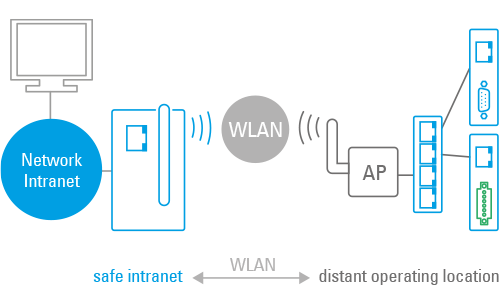
Illustration 1 shows monitoring of a door contact and temperature at a remote location using a WLAN Client Bridge. The remote installation consists of an access point, a Web-IO Digital and a Web-Thermograph, which are connected to each other through the LAN port of the access point.
This Ethernet island is linked through the WLAN Client Bridge installed in the master network. Although the arrangement of Client Bridge and access point makes no difference in terms of pure function, the access point was intentionally located on the remote side as a potential starting point for network attacks. When successful, if the Bridge is turned off an attacker gains access only to the sensor network and not to the sensitive master network. Accessibility of the remote network by other WLAN clients still remains intact.